Skip to content

The best wedding planning apps in Australia (2026)

Here is what each of the nine costs, and where each one stops.

Compiled by Jordan, founder of Managing Matrimony. Facts checked October 2026, from each provider's own website.

The nine wedding planning apps Australian couples come across in 2026 are Managing Matrimony, Easy Weddings, Bridebook, Say I do, WedSites, Centrepiece, Ivory Lane, The Knot and Joy. Most have a free plan. They differ on the guest limit, on seating, run sheets and printing, and on whether they are built for Australia.

See them side by side

Most wedding planning apps do the same four things: a guest list, a checklist, a budget and a website with RSVPs. After that they go their own ways.

For an Australian wedding the differences that matter are practical: prices in Australian dollars rather than a converted figure and a foreign transaction fee, a directory with Australian businesses in it, dates and phone numbers written the way you write them, a clear position on GST, and whether there are real people behind the software when something goes sideways three days out.

Every app, side by side

An em dash means the provider's own pages do not say either way. Limited means they describe it only on a paid plan, only in part, or not for a wedding in Australia.

All nine apps, line by line
Nine wedding planning apps: their free tier, price, guest cap, features and whether they are Australian
AppFree tierFromGuests on freeWebsite and RSVPSeatingRun sheetPrintAustralian
Managing MatrimonyYes$149Up to 100YesYesLimitedYesYes
Easy WeddingsYesFree—YesYes——Yes
BridebookYesFree—YesLimited—YesNo
Say I doYes$25 or $69Up to 20 or 85YesLimitedLimited—Yes
WedSitesTrial$59—LimitedLimitedLimitedNoYes
CentrepieceYes$13 a monthUp to 150YesYesLimitedYesYes
Ivory LaneYes$99Up to 100LimitedLimitedYes—Yes
The KnotYesFree—YesLimitedYesLimitedNo
JoyYesFreeUnlimitedYes—LimitedYesNo

Which app for which job

Who each app suits, in one line. This is not a ranking, and we are on the list ourselves.

  1. Managing Matrimony

    Couples who want the planning, the printed stationery and, if they want it, a real coordinator from one place.

  2. Easy Weddings

    Couples whose first job is shortlisting Australian venues and vendors.

  3. Bridebook

    Couples who want a free checklist, budget and guest list they can both edit from their phones.

  4. Say I do

    Couples who mainly need a wedding website and RSVPs.

  5. WedSites

    Couples who care most about designing the wedding website themselves.

  6. Centrepiece

    Couples ordering signage and place cards who want the seating plan to fill them in.

  7. Ivory Lane

    Couples who want one connected planner with a run sheet, and are finding their vendors themselves.

  8. The Knot

    Couples marrying in the United States.

  9. Joy

    Couples who want a free wedding website with RSVPs and a shared photo album, and will plan the rest elsewhere.

The questions that change the answer

Before you open nine tabs, it helps to know which questions change the answer. These are the eight that couples ask us about.

  1. Free, one payment, or a subscription

    Some of these are free with no paid tier at all. Some are free to a guest cap and then ask for one payment you never repeat. One is a subscription, by the month or the year, and a wedding takes twelve to eighteen months, so do the sums before you start.

  2. The guest cap on the free plan

    Free rarely means unlimited, and the cap is usually what decides whether you ever pay. Count your list first, then check the guests-on-free column in the table above.

  3. Website and RSVPs together

    Nearly all of them build you a wedding website. Fewer bring the RSVPs back into the same guest list, and that is the part that saves you the spreadsheet.

  4. Seating, and whether there is a floor plan behind it

    Putting guests on a table is not the same job as laying the tables out in the room. Some do the first, a couple do both, and not every app describes either.

Four more questions to ask
  1. A day-of run sheet

    The document your photographer, celebrant and venue all ask for in the last fortnight. Not every app here has one, and some keep it behind a paid plan. The table above says which.

  2. Printed stationery, and where it comes from

    A directory of stationers is a different thing from a product that prints your own guests' names onto the place cards. Both kinds are in the list below.

  3. Guest photo sharing

    A QR code on each table that collects everyone's photos into one album. It is newer, and only some of these apps have it.

  4. American or Australian

    An American app still works here. It may also price in US dollars, fill its directory with businesses you cannot book, and write its dates month first. If you are marrying in Australia, that is friction you do not need.

The apps, and what each is for

Managing Matrimony

We make Managing Matrimony, so treat this section as the interested party talking.

Managing Matrimony is our own platform. It puts the planning tools, the printed stationery and a coordination team under one roof, all from the same company.

What it does well, and where it stops

The three are joined up. Your guest list feeds the seating plan, the seating plan exports as a PDF of names and seat numbers for the venue, and the same names print onto the place cards. Our paid plans are a single payment rather than a subscription, the vendor directory is Australian, and our coordination packages are listed with their prices rather than behind a quote form.

It runs in your browser, and there is no phone app. The free plan stops at 100 guests, and sending invitations and the run sheet need Manage, the $149 plan. The wedding website has no custom domain. Our coordinators work in Sydney and regional NSW only. We are also the newest name here, which matters if a long trading history is what reassures you.

Price
Managing Matrimony is free up to 100 guests; paid plans run $149 to $399 as one payment.
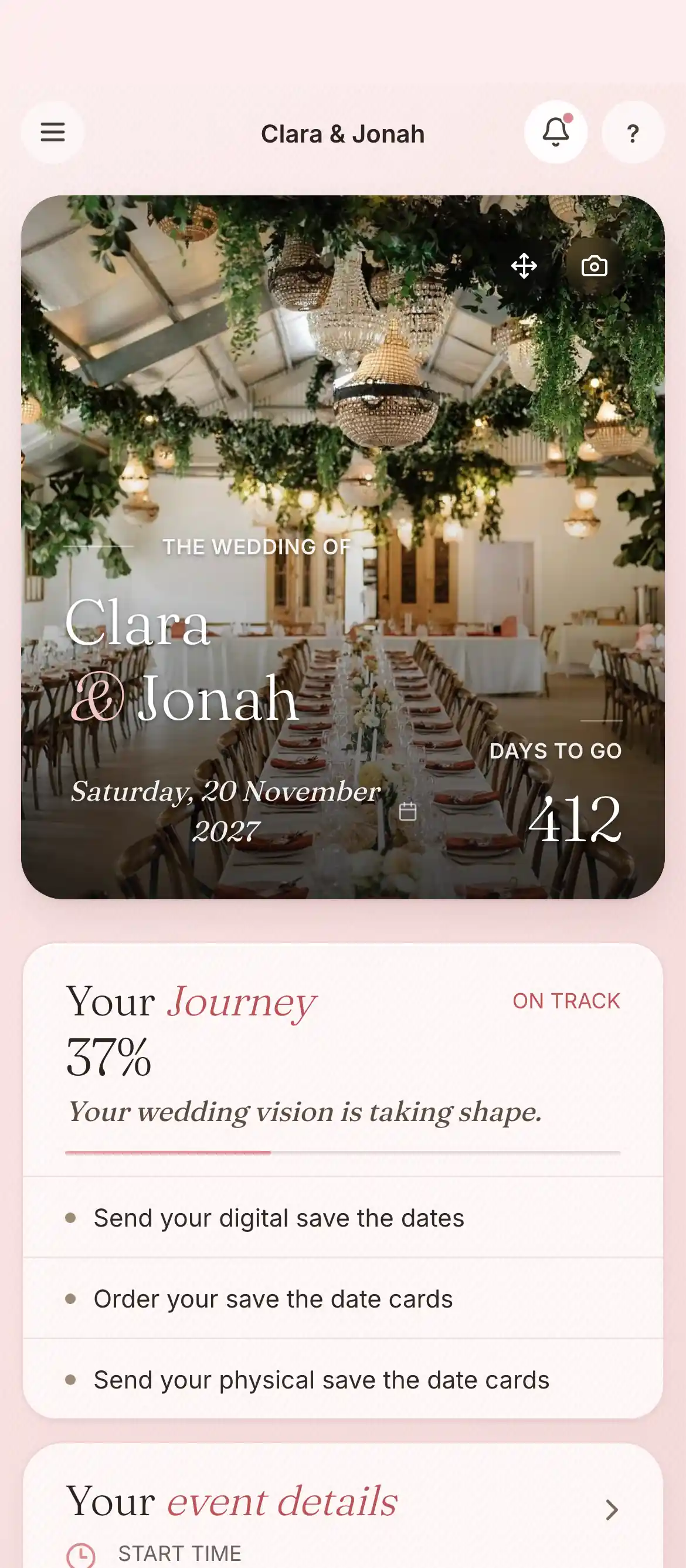
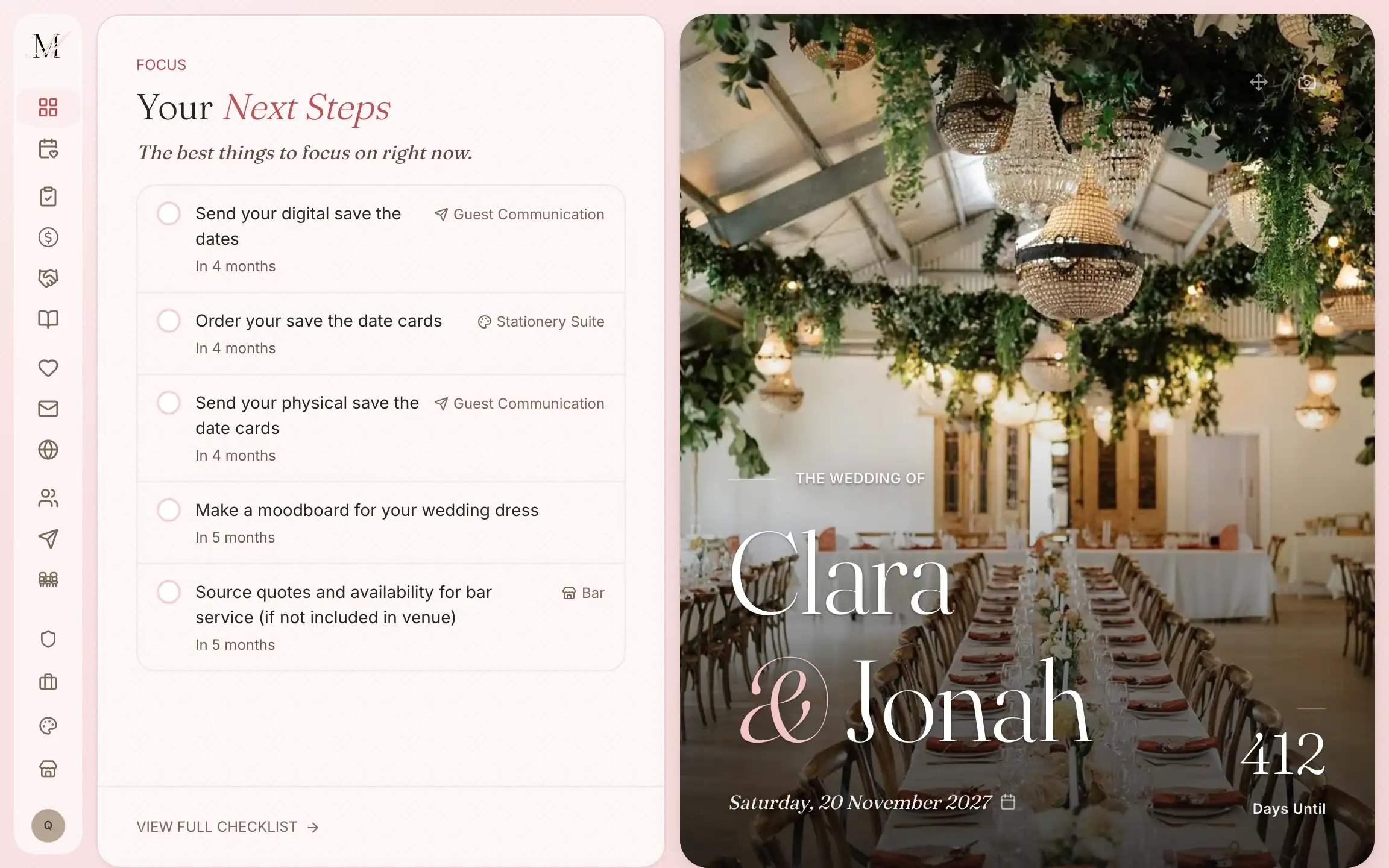
The dashboard in the platform: the next steps, each with when it is due, beside the cover with the couple's names, their date and the days to go. A demonstration wedding.

Easy Weddings

Easy Weddings is the Australian incumbent: a wedding planning platform built around a directory of Australian vendors, with free planning tools alongside it and a paid planning service of its own.

What it does well, and where it stops

It is built for finding people: more than five thousand Australian wedding businesses, with reviews and messaging inside the app, and more than twenty-six years of trading behind the listings. The checklist, budget, guest list, seating and a free wedding website with RSVPs all sit in one free account, and there are real iOS and Android apps. Its own planners also plan weddings Australia-wide, as a paid service that writes your run sheet, with an on-the-day coordinator as an add-on.

Its pages describe no tool for sending digital invitations: the e-invitations page is general advice about e-invitations. Nor do they describe printing your own stationery; the invitations section is a directory of other businesses to contact. The free planning tools describe no run sheet (its planners write one as part of the paid service), and no export beyond saving the seating plan as a PDF.

Price
Easy Weddings' planning tools are free; its planning service is $1,320 or $1,980 inc. GST.

Easy Weddings alternatives for Australian couples

Bridebook

Bridebook is a free planner built in London, with an Australian edition at its au-en address. It covers the checklist, budget, guest list, venue search and a wedding website.

What it does well, and where it stops

It is free for couples, with apps on both phone stores. Their pages state every couple gets the core tools at no cost, a partner can be added as a collaborator on the checklist and guest list, and the wedding website is free with a link search engines will not index and an optional password. A separate storefront sells printed save the dates and invitations, though its pages do not say whether it delivers to Australia.

Its pages describe seating only as part of the guest list: guests can be grouped into tables, and the list exported to make seating arrangements simpler. They describe no table plan, floor plan or day-of run sheet. RSVP forms go to guests by email, and no digital invitation is described to send with them. The company is registered in London, and the Australian pages are a localised edition of the same product.

Price
Bridebook is free, and its pages list no paid plan.

Bridebook alternatives for Australian couples

Say I do

Say I do is a planner built around the wedding website, free to start, with the site, the guest list, online RSVPs, the checklist and digital invitations. Its terms name an Australian company.

What it does well, and where it stops

Its prices are a one-time cost rather than a subscription, and RSVPs are offered in thirteen languages, which is worth something if half your family replies in another one. It runs in a browser, and you can save it to your phone's home screen.

Its pricing page shows one of two price lists, and on the one with named packages the seating planner and the digital invitations come only with a paid package. No budget or expense tracker appears on any product page. Partners share one account by sharing a sign-in rather than having separate logins. Its pages describe a timeline for guests on the wedding website, but no day-of run sheet, vendor directory or printed stationery.

Price
Say I do's pricing page shows one of two price lists. One is free up to 85 guests, then $69 to $149 as one payment; the other is free up to 20 guests, then priced by guest count, from $25 for up to 40 guests, as one payment.

WedSites

WedSites is a wedding website builder made in Melbourne, with planning tools behind it: guest list, RSVP, budget, checklist, seating and timeline in one dashboard.

What it does well, and where it stops

The website is the point. It is a drag-and-drop builder for couples who want to customise every section of the site. The two upper plans add households and groups for plus-ones and multi-event RSVPs, both partners can work in it, and every plan is a one-time payment rather than a subscription, with six to twenty-four months of hosting.

The free trial lets you design the site but not publish it, and almost everything sits behind a tier: the cheapest paid plan has no guest list and no online RSVP, and the budget, checklist, seating chart and day-of timeline are top-plan only. Their own comparison articles record the seating tool as list-based rather than a visual floor plan, mark the platform as digital-only for paper stationery, and state there is no mobile app.

Price
WedSites' paid plans run $59 to $319 as one payment; its free trial lets you design the site but not publish it.

Centrepiece

Centrepiece comes from a signage studio in Adelaide: a free RSVP site, seating and floor plan whose details fill in the signage, table numbers and place cards you order from the same company.

What it does well, and where it stops

It is built for the step from screen to paper. Signage and place cards arrive with your names, table count and guest list already in them, because the same in-house team makes the signs. It does seating and a floor plan, and there is an interactive demo loaded with sample data you can open without an account.

Their pages describe a vendor tracker for contacts you enter yourself, and no directory of wedding businesses to search. The run sheet, the digital invitation emails and the full budget ledger are behind the paid Pass, and the Pass is a subscription rather than a one-off payment, which is the odd one out here.

Price
Centrepiece is free up to 150 guests; the Centrepiece Pass is $13 a month or $109 a year.

Ivory Lane

Ivory Lane is a free planner built in Melbourne, pitched as the replacement for the spreadsheet and the disconnected apps: one workspace where the numbers all recalculate together.

What it does well, and where it stops

Everything is connected, and it is localised for Australia. Guest count, budget, vendor payments and seating recalculate from one shared dataset, both partners are in the plan on Free or Premium, and the Australian details are there, including the Notice of Intended Marriage. Its day-of run sheet is free to build, and Premium adds a Wedding Inbox address that files vendor quotes into the plan.

The free wedding website has no RSVP: collecting replies is a Premium feature, as is the visual seating canvas (the free plan has a seating list). Their vendor marketplace has not launched; their own page says it is due late in 2026. And there is no app to download yet: it is a web app you save to the home screen.

Price
Ivory Lane is free up to 100 guests; paid plans run $99 as one payment.

The Knot

The Knot is the American incumbent: a free all-in-one planning platform paired with a marketplace of local wedding vendors, which its pages say has helped more than thirty million couples.

What it does well, and where it stops

One dashboard holds everything: checklist, budget, wedding vision, guest list, registry, vendors and a wedding day timeline. Behind it is a marketplace of close to one hundred and seventy-five thousand vendors across twenty categories, backed by four million couple reviews. Their Peace of Mind Program helps you find a replacement, and may cover part of the price difference, if a covered vendor cancels between ninety and fourteen days before the wedding.

It is built for the United States, and its own help pages say so in detail. Its tools work in US dollars only, and couples on another currency are told to convert first. The marketplace lists venues by American state and city. Printed paper is not posted outside the States, and cash gifts are taken in US dollars only. Its help centre says the app is no longer offered to international users, and that guests in other countries may not be able to open the wedding website or RSVP on it. The app's store listing describes a seating tool; the help centre's list of tools names no seating chart or floor plan.

Price
The Knot is free. Its paid extras are priced in US dollars: custom domain, printed stationery.

The Knot alternatives for Australian couples

Joy

Joy is an American wedding website, registry and planning platform. Its free plan holds the website, online RSVPs, unlimited guests, hundreds of digital invitations and the app, and the website carries a shared photo album.

What it does well, and where it stops

The free website, and the sharing around it, are what it does well. Save the dates, invitations and eCards go out from the guest list by email or a shareable link, and you can see who has opened, read and replied. Guests upload photos through the Joy app to a shared album before, during and after the day, and it can play as a live slideshow at the reception. The site is offered in Australian English.

Paper takes time: their print help page puts delivery to Australia at nine to twenty-one days. Text messages reach United States and Canadian numbers only, so invitations here go by email or link. For the planning, their free-plan feature list names no seating chart, floor plan, budget tracker or checklist, and a custom domain, text messaging and the premium designs cost extra.

Price
Joy is free. Its paid extras are priced separately: printed cards, custom domain and text messaging.

Joy alternatives for Australian couples

What couples ask us about this list

What is the cheapest way to plan an Australian wedding online?

The cheapest way is free: Managing Matrimony, Easy Weddings, Bridebook, Say I do, Centrepiece, Ivory Lane, The Knot and Joy all publish a free plan. What separates them is the guest cap on that plan and what it leaves out, so compare those in the table rather than the price.

Do I pay per guest?

None of these publish a price per head. Some cap the free plan at a guest count and ask for a payment past it, and one of Say I do's two price lists sets its price by guest count. Our free plan covers up to 100 guests, and the rest are in the table. Count your list first, because the cap is often what decides whether you ever pay.

Do these prices include GST?

Ours do: every price on our pricing page includes GST, and the page says so. The other pricing pages say nothing either way, so ask before you buy if it matters to you.

Two more questions

Is an American wedding app a problem for an Australian wedding?

Not fatal, but it is friction: converting prices, a foreign transaction fee, a directory full of businesses you cannot book, month-first dates, and phone numbers losing the zero at the front on import. If all you want is a free wedding website, an American app can do it, though The Knot's help centre warns that guests outside the United States may not be able to open the site. For the guest list and the money, an Australian one saves you the translation.

Can I use two of these at once?

Yes: one for finding vendors, another for the planning. Keep the guest list in a single app, though. It is what the seating chart, the RSVPs, the place cards and the run sheet all read from, and two copies of it is how people end up with a table for eleven.

There is no single right answer here, and you are allowed to use two. The only rule worth holding to is that the guest list should live in one app, because that is the list every other job reads from.

If you want to see ours

The free plan covers up to 100 guests: your guest list, a wedding website with RSVPs, the checklist, the budget and the seating plan. No card to start.

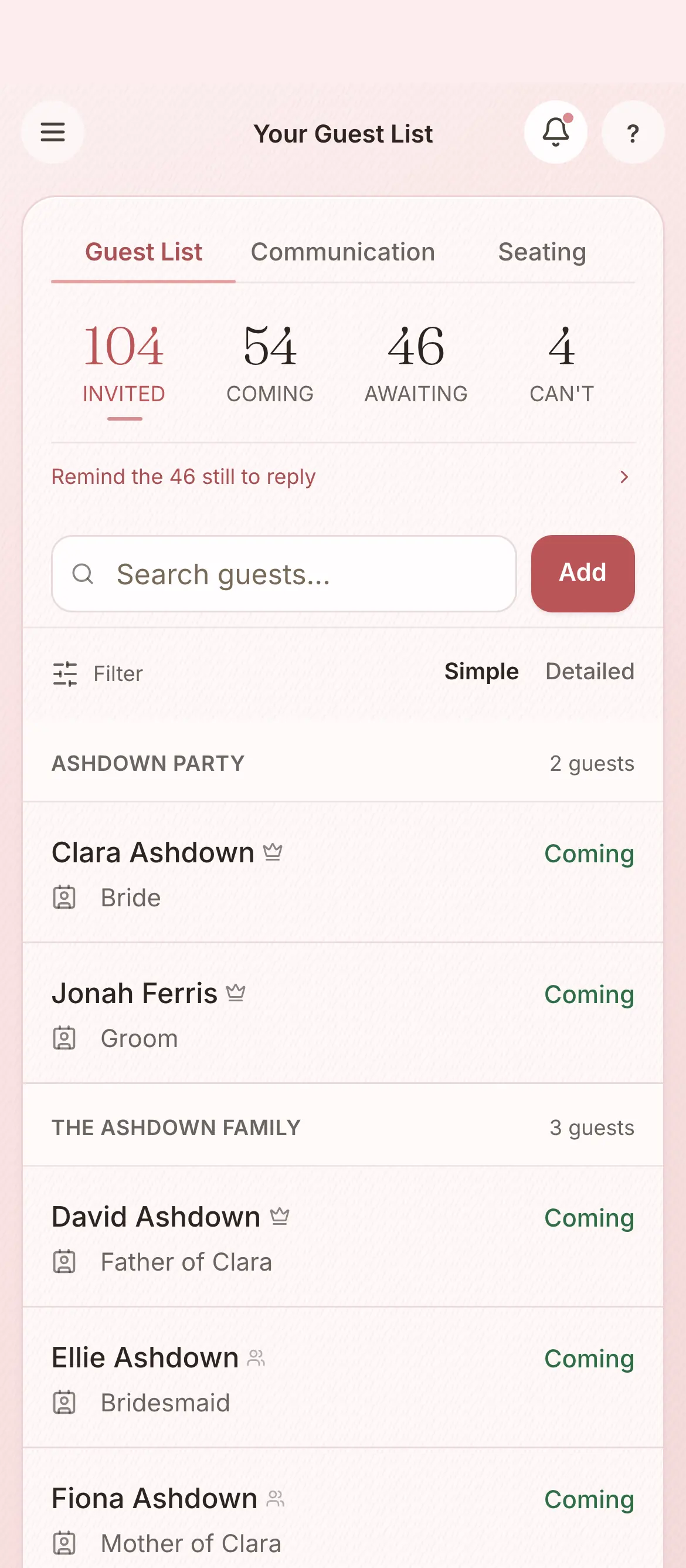
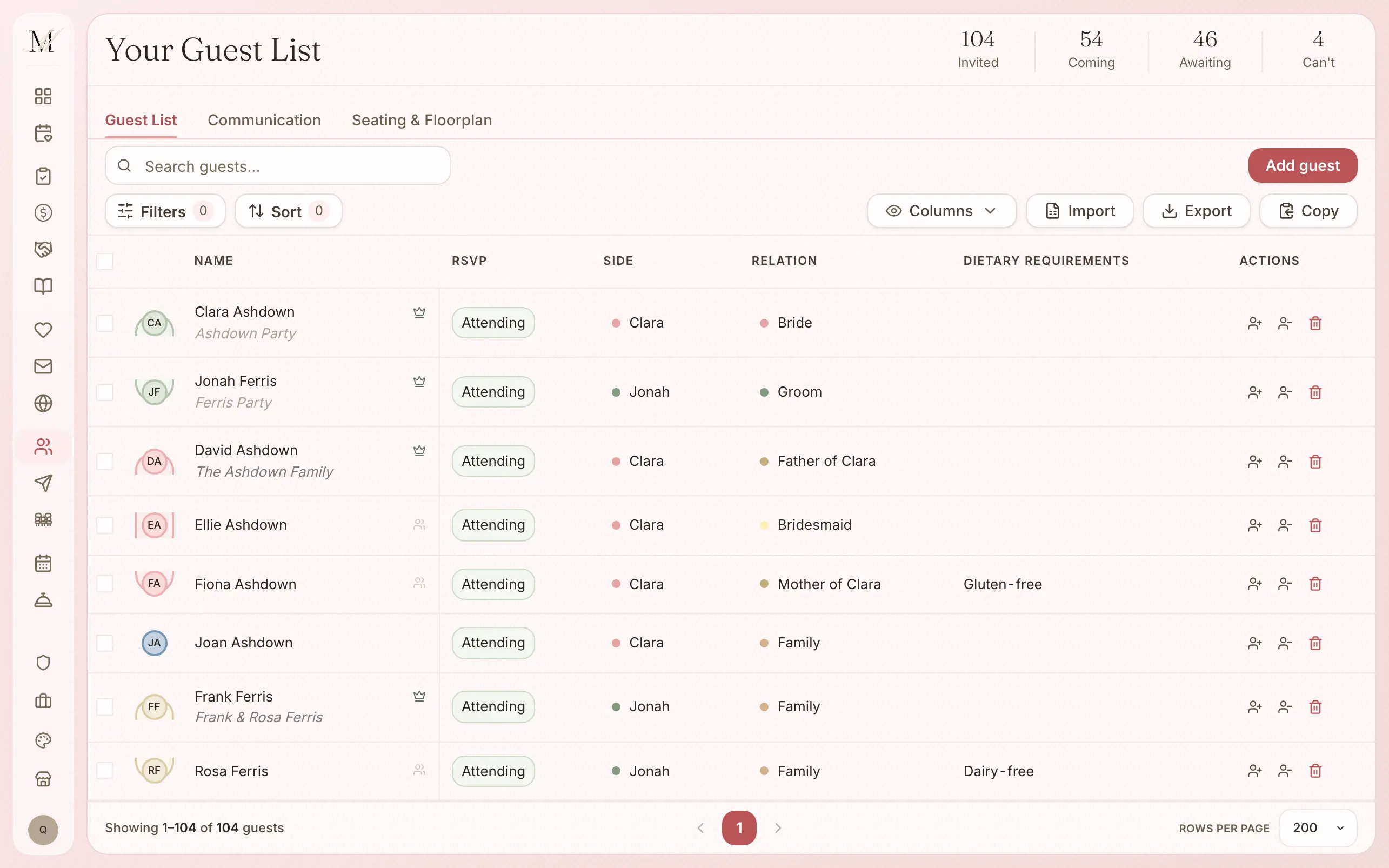
The guest list in the platform: 104 invited and 54 coming, with each guest's reply, side, relation and dietary need. A demonstration wedding.