Average Wedding Cost Australia 2026: $38,252 Breakdown
The short answer
- Australian national average: $38,252
- NSW average: $42,322
- Average original budget: $29,471
- Average overspend against the original budget: 23%
- Average actual guest count: 85, down from 108 originally expected
The practical lesson is not “budget exactly $38,252”. It is to price your actual guest count and priorities, then keep a real contingency. Averages blend restaurant weddings, private estates, regional celebrations and large premium events into one number.
The best 2026 Australian wedding-cost benchmark is $38,252 nationally. In New South Wales, the reported average is $42,322.
Those figures come from the Easy Weddings 2026 Australian Wedding Industry Report, which combines responses from more than 4,200 engaged and recently married couples, 540 wedding businesses, marketplace data and its 68,000-person Instagram community. It is a useful market benchmark, not a promise that your wedding should cost that amount.
What the 2026 data actually covers
The report is industry research, not Managing Matrimony client data.
The report's state averages are:
| State or territory | Average wedding cost |
|---|---|
| NSW | $42,322 |
| Victoria | $39,502 |
| Western Australia | $35,961 |
| South Australia | $34,888 |
| Northern Territory | $33,750 |
| ACT | $32,915 |
| Queensland | $32,645 |
| Tasmania | $25,423 |
| Australia | $38,252 |
Use the state number as context only. Your quotes, contract inclusions, guest count, date and venue format are the figures to decide on.
2026 category benchmarks
These are reported averages from the same 2026 industry report. They are not a menu to add mechanically: some venue packages include food, beverages, staffing or accommodation, while standalone catering data includes specialist providers such as mobile bars and food trucks.
| Category | 2026 benchmark | Scope |
|---|---|---|
| Reception venue | $17,518 | Australian national average; NSW $18,662 |
| Catering | $6,177 | Australian national average across broad catering types |
| Marriage celebrant | $1,031 | Australian national average; NSW $1,014 |
| Photography | $3,865 | NSW average |
| Flowers | $2,639 | Australian national average |
| Wedding dress | $2,591 | Australian national average; designer average $4,475 |
| Formal wear | $2,102 | Australian national average |
| Music | $2,185 | NSW average |
| Invitations | $1,001 | Australian national average |
| Hair and makeup | $1,159 | NSW average |
| Wedding cars | $1,506 | NSW average |
Start by collecting comparable quotes from venues, caterers, photographers, florists, celebrants and bands and DJs. Compare the same hours, quantities, staffing, delivery, set-up, pack-down, travel and tax treatment.
Why guest count changes the budget fastest
The 2026 report says couples expected 108 guests but averaged 85 in reality. That 23-person reduction affects much more than meals. It can change the venue you need, beverage quantities, furniture, invitations, transport, cake, staffing and accommodation.
Build three totals before signing a venue:
- Fixed costs: photography, celebrant, entertainment and core attire.
- Per-person costs: food, beverages, furniture, stationery and transport.
- Threshold costs: expenses that jump when a guest count requires a bigger room, extra staff, another bus or an assistant coordinator.
That makes “what happens if we invite ten more people?” answerable before the decision is emotional. Wedding cost per head in Australia works through which costs move with each guest.
What is included in the legal paperwork cost?
There is no marriage licence in NSW, or anywhere in Australia. Couples give a Notice of Intended Marriage (NOIM) to an authorised celebrant at least one month and no more than 18 months before the wedding. The federal Attorney-General's Department explains the process.
Your celebrant's fee covers their professional service and legal work according to their package. After the marriage, an optional official NSW marriage certificate is currently $70 standard or $105 priority, including listed postage and handling, according to NSW Births, Deaths & Marriages fees. Check the government page again when you apply because fees can change.
A budget method that survives real quotes
1. Start with the money actually available
Separate confirmed savings and confirmed contributions from hoped-for gifts. Do not make a booking against money that has not been agreed.
2. Reserve contingency before allocating categories
Keep 10-15% unallocated until final invoices. The report's 23% average overspend is a warning that an optimistic spreadsheet is not enough.
3. Price the guest-dependent core first
Venue, food and drink usually set the shape of the whole budget. Obtain written inclusions and model at least two guest counts.
4. Choose two or three priorities
Put more into the parts you care about and hold the rest to explicit caps.
5. Track committed and paid amounts separately
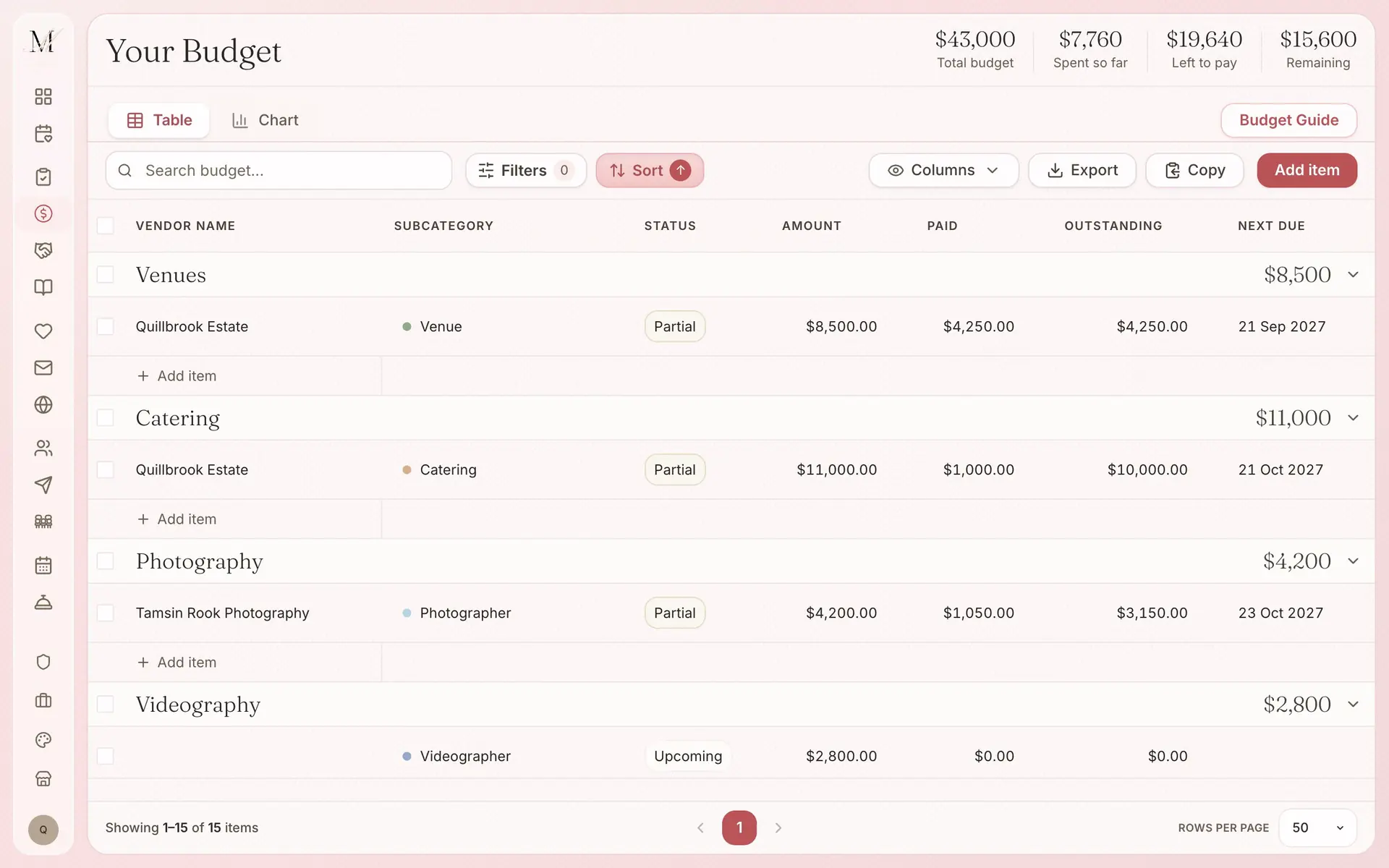
A quote, a signed contract, a deposit and a final payment are four different states. Managing Matrimony's budget tracker keeps vendor commitments and payments together so the plan does not go stale after deposits begin.
Questions to ask before accepting a quote
- Is GST included?
- What guest count or quantity is included?
- Are staffing, travel, delivery, set-up and pack-down included?
- What triggers overtime or extra staffing?
- Is a tasting, trial or revision round included?
- What is non-refundable?
- Which date does the quote expire?
- What can change after the contract is signed?
A good budget is not necessarily the smallest one. It is one where you can see every assumption, the sums add up, and every invoice is tracked from the first deposit to the final payment.
Where these numbers come from: the Easy Weddings 2026 Australian Wedding Industry Report (more than 4,200 couples and 540 wedding businesses), checked on 1 October 2026. NSW certificate fees from NSW Births, Deaths and Marriages, current as of 1 July 2026. The coordination price is our own.
Corrected 2 September 2026: an earlier version described these figures as Managing Matrimony averages. They are from the report named above.
Questions couples ask us
What is the average cost of a wedding in Australia in 2026?
The Easy Weddings 2026 Australian Wedding Industry Report gives a national average of $38,252 and a NSW average of $42,322. Treat an average as market context, then build your budget from your own guest count, quotes and priorities.
What is the biggest wedding expense?
The 2026 report says the reception venue accounts for 46% of the wedding budget and gives a national venue average of $17,518. Confirm whether food, beverages, staffing, accommodation, set-up and pack-down are included before comparing venue quotes.
How much contingency should I keep?
A practical starting point is 10-15% of the total budget. The 2026 report found couples spent an average of 23% above their original budget, so contingency should be reserved before categories are fully allocated.
Do couples need a marriage licence in NSW?
No. There is no marriage licence in NSW, or anywhere in Australia. Couples lodge a Notice of Intended Marriage with an authorised celebrant at least one month and no more than 18 months before the wedding. An optional official NSW marriage certificate is currently $70 standard or $105 priority; check the NSW Government fee page when applying.
How does guest count affect a wedding budget?
Guest count changes food, drink, stationery, furniture, transport and staffing, and can push a wedding into a larger venue or vendor package. Model fixed costs, per-person costs and threshold costs separately before finalising the list.