What a Wedding Coordinator Actually Does on the Day
An on-the-day coordinator runs the wedding so you do not have to. Here is the work, from vendor liaison six weeks out to the last box in the car.
28 September 2026
Updated 8 October 2026
4 min read
Jordan
Founder & Lead Wedding Coordinator, Managing Matrimony
An on-the-day wedding coordinator runs your wedding day so that nobody has to ask you where the cake goes. The work starts four to six weeks before the wedding, when we take over talking to your vendors, and it finishes when the personal decor is packed down at the end of the night. The sample wedding in our run sheet builder has 76 moments in it between 11am and 11pm, and most of them are things you should never have to think about.
It starts weeks before the day, not on it
The first piece is a consultation and a structured brief: your venues, your vendors, your people, and the personal details that only you know about. Where the photos of your grandparents go. Which uncle should not be given a microphone.
Then at four to six weeks out we start talking to your vendors directly. Every one of them has a version of your day in their head, and those versions never quite match. The florist thinks they are delivering at two, the venue thinks the room is theirs until three, the photographer has budgeted forty minutes for portraits that the drive alone will eat. Reconciling that is unglamorous and it is most of the value. By the end you have one run sheet, and everybody working on your wedding is reading the same one.
The final handover
Before the wedding we confirm four things in writing: access, contacts, cues and decisions. Who can get into the room and when. Who to call for each vendor on the day, not the office number. What signals the ceremony to start and the speeches to run. And who decides, if the weather turns or a vendor is late, so that the answer is not "ask the bride".
If something is still open, this is where it becomes visible. Open questions cost almost nothing on a Tuesday and a great deal at half past three on a Saturday.
The day itself
On the sample run sheet the day opens at 11am with breakfast for the wedding party, and the first vendors through the door are the florist, the photographer and the videographer at midday. Hair and makeup run through the early afternoon against the clock. The cake arrives at 2pm and the dress goes on at 2:25pm, which is the point at which the room stops being a getting-ready room and starts being a schedule.
Guests arrive at half past three. The ceremony runs 4pm to 4:30pm, and cocktail hour opens the moment it ends. From there the day is a series of handovers: canapes at 4:45pm, wedding party photos at 5pm, guests walking to the reception at 5:45pm, doors at 6pm. Entrances, cake cut, entrees at 6:30pm. Sunset photos at 7:04pm, which is the one moment of the night that cannot be moved. Speeches around the mains, first dance, dance floor at 9pm, late-night drinks and snacks at 10pm.
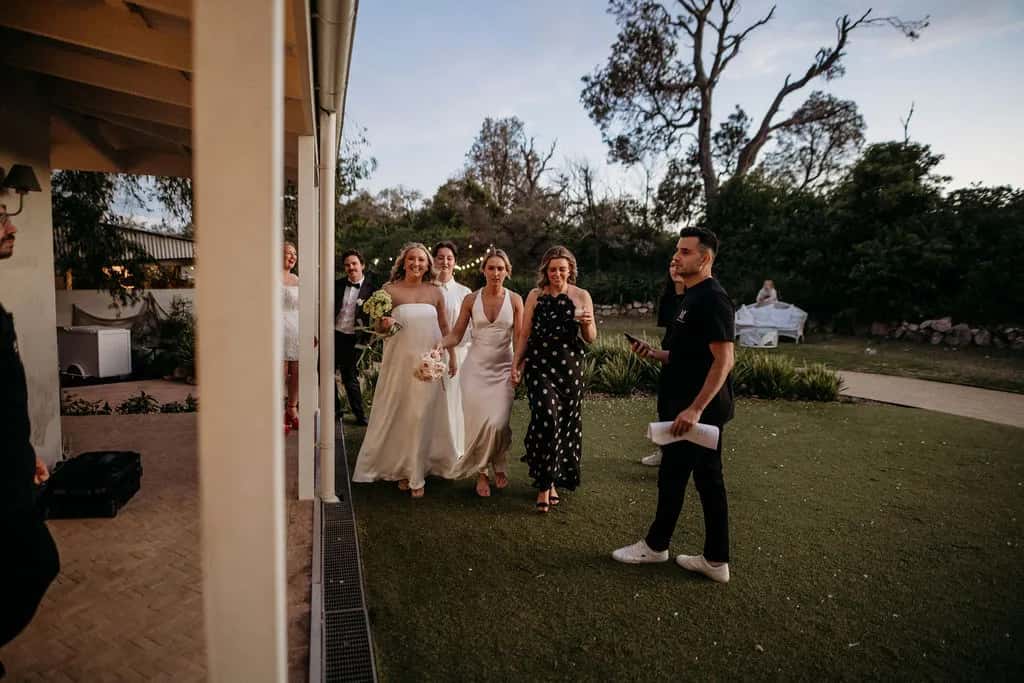
The coordinator is the person moving between all of it. Cueing the ceremony. Getting the wedding party to the right place four minutes before they are needed. Telling the DJ that the speeches have run long and the first dance is moving. Finding the box of place cards. Being the number every vendor calls, so that none of them call you.
It ends with the pack-down. Somebody has to gather the signage, the framed photos, the leftover bomboniere and the wishing well, and get them into a car that is not yours, at the point in the night when everyone who loves you is least equipped to do it. Basic pack-down of personal decor before we leave is part of the booking, and it is the piece couples never think to ask about until the Sunday morning.
What a coordinator does not do
Worth being straight about, because the line matters more than the list:
- Full planning, budget management and sourcing your vendors are a separate service, not part of on-the-day coordination.
- Styling design, decor hire and floral sourcing sit with Styled & Sorted, our styling package, rather than here. We set the personal details you supply as time and venue access allow.
- The venue stays responsible for its own operations: its staff, its food and beverage service, its equipment and its site.
Eight hours, ten or twelve
| Coverage | Usually right when |
|---|---|
| 8 hours | One site, or a short trip between two, with a standard reception |
| 10 hours | Separate ceremony and reception venues, or a long set-up |
| 12 hours | Set-up from the morning, two sites, or a late finish |
On-the-day coordination starts from $2,200 inc. GST for eight hours, and your quote confirms the figure for a longer day. Travel between a ceremony venue and a reception venue happens inside your booked hours, not on top of them. To choose, put your own run sheet next to the clock. Coverage starts when we do, not when the ceremony does, so if you want us there while the florist is still working, count the morning in. If the ceremony is the part you are anxious about and the reception looks after itself, Coordination Lite covers six hours from $1,650 inc. GST instead. Both sit on our coordination page.
Two related reads: a coordinator and a planner are different jobs, and if you would rather build the run sheet yourself first, the free template is the same one our run sheet builder generates on the Manage plan.
Timings from the Managing Matrimony run sheet engine's sample day, September 2026.
One calm home for the whole plan
Budget, guest list, runsheet, website and stationery — everything in this article lives in one place, built for Australian couples. Free to start, no credit card.
Start freeGood to know
Frequently asked questions
Is an on-the-day coordinator the same as a wedding planner?
No. A planner helps you make the decisions over months, including budget and sourcing vendors. A coordinator takes the decisions you have already made and runs them. We start four to six weeks out, take over vendor liaison, and run the day itself.
When does the coordinator start working on our wedding?
At booking we do a consultation and take a full brief. The active work starts four to six weeks before the wedding, when we contact your vendors directly, reconcile everyone's timings and build one run sheet the whole team works from.
Does the coordinator set up our decorations?
We set the personal details you supply, such as place cards, menus and signage, as far as time and venue access allow. Styling design, decor hire and floral sourcing are a separate service, and the venue handles its own furniture and anything promised in its contract.
What happens if a supplier runs late?
We handle it, and you usually hear about it afterwards. Because we hold every vendor's mobile number and the run sheet they agreed to, a late arrival becomes a conversation between us and them, and a small adjustment to the order of the afternoon.
How many hours do we actually need?
Put your run sheet next to the clock and count from when you want us on site. Eight hours suits one venue and a standard reception, ten covers separate ceremony and reception sites, and twelve covers a morning set-up or a late finish. Coordination starts from $2,200 inc. GST for eight hours, and your quote confirms the figure for your hours.
Jordan
Founder & Lead Wedding Coordinator, Managing Matrimony
Jordan founded Managing Matrimony in 2024 and leads its team on the day. The Sydney family team coordinates weddings across Sydney and regional NSW, and built the wedding planning platform it runs them on.